ABSTRACT
A probability distribution defines how probability mass is allocated across a sample space . It ensures that the likelihood of any specific outcome is between 0 and 1, and that the total likelihood of all possible outcomes sums exactly to 1.
Probability Distributions
A distribution is a function such that:
Examples of Discrete Distributions
- Fair Coin: , where and .
- Fair Six-Sided Die: , where for all .
- Standard Deck of Cards: , where .
Distribution of an Event
The probability of an event is the sum of the probabilities of the individual outcomes contained within that event:
- Certainty:
- Impossibility:
The Law of Total Probability
The Law of Total Probability allows you to calculate the probability of an event by “weighting” it across different scenarios (a partition of the sample space).
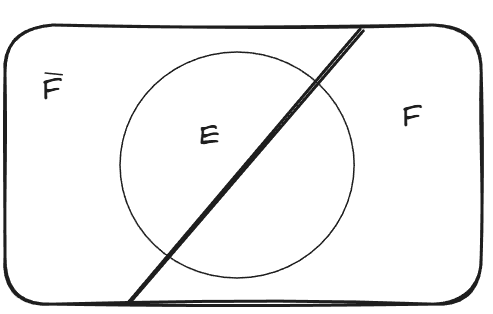
Partitioning with Complements
For any two events and , you can calculate by looking at cases where occurs and where it does not ():
General Form
If is a partition of the sample space (meaning they are mutually exclusive and their union is ), then for any event :
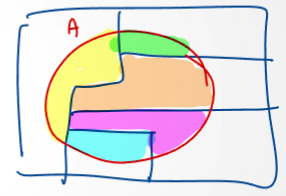
Example: Maximum of Two Dice
Question: What is the probability that the maximum of two dice rolls is greater than 4?
Let be the event that . We can partition the space based on the first roll:
- Event : The first roll is .
- : Given the first roll is , the second roll must be or for the max to be . Thus, .
- Event : The first roll is .
- : Since the first roll is already , the condition is satisfied regardless of the second roll. Thus, .
Calculation:
Related Notes
- Conditional Probabilities: The Law of Total Probability is the denominator used in Bayes’ Theorem.
- Case Analysis: This is the practical application of the Law of Total Probability to simplify complex problems.
- Random Variables: Distributions of events form the basis for Probability Mass Functions (PMFs).