ABSTRACT
Independence describes a relationship between two or more events where the occurrence (or non-occurrence) of one provides no information about the likelihood of the others. It is a fundamental property used to simplify complex probability calculations.
Defining Independence
Two events and are independent if the occurrence of one does not change the probability of the other. Mathematically, this is expressed through Conditional Probabilities:
Using the definition of conditional probability, we derive the Product Rule for Independent Events:
If this equality holds, the events are independent. If it does not, the events are dependent.
Independent vs. Disjoint Events
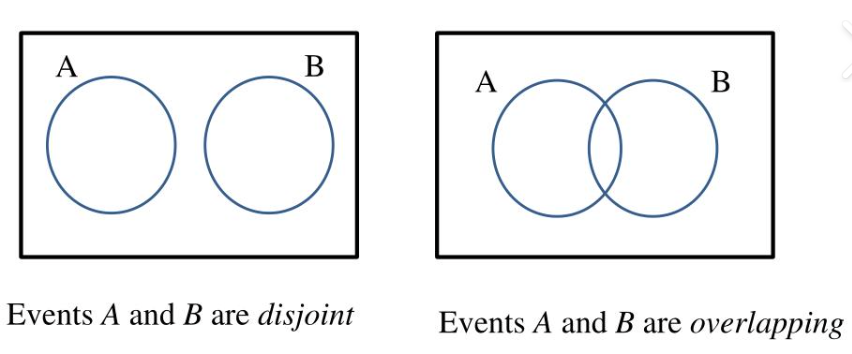
A common point of confusion is the difference between independent events and disjoint (mutually exclusive) events.
IMPORTANT
Independent events are NOT the same as disjoint events. In fact, if two events with non-zero probability are disjoint, they must be dependent because the occurrence of one guarantees the other did not occur ().
| Feature | Independent Events | Disjoint Events |
|---|---|---|
| Can occur together? | Yes | No |
| Influence | No influence on each other | One excludes the other |
| Formula | ||
| Visual | Overlapping regions | Non-overlapping circles |
Example: Bitstring Properties
Suppose we generate a random bitstring of length 4.
- Event : The string starts with a 1.
- Event : The string contains an even number of 1s.
Step 1: Calculate individual probabilities
- (half the strings start with 1), so .
- (in bitstrings of length , exactly half have an even number of 1s), so .
Step 2: Calculate the intersection
- , so .
Step 3: Test for independence
- Does ?
Since the equality holds, events and are independent. Knowing that the string starts with a 1 gives you absolutely no advantage in guessing if the total count of 1s is even or odd.
Pairwise vs. Mutual Independence
When dealing with more than two events ():
- Pairwise Independence: Every possible pair satisfies .
- Mutual Independence: The probability of the intersection of any subset of events is the product of their individual probabilities.
NOTE
Pairwise independence does not guarantee mutual independence.
Related Notes
- Conditional Probabilities: The foundation for defining how events interact.
- Linearity of Expectation: A property that holds true regardless of whether events are independent or dependent.
- Binomial Distribution: Built on the assumption of independent Bernoulli trials.