ABSTRACT
Linear Probing is a collision resolution strategy within the Open Addressing (or Closed Hashing) family. When a key’s natural hash index is occupied, the algorithm “probes” the very next sequential slot in the array. This continues until an empty slot is found or the table is determined to be full.
1. The Core Concept: Sequential Search
In Linear Probing, the algorithm follows a simple deterministic path: if is full, try , then , and so on.
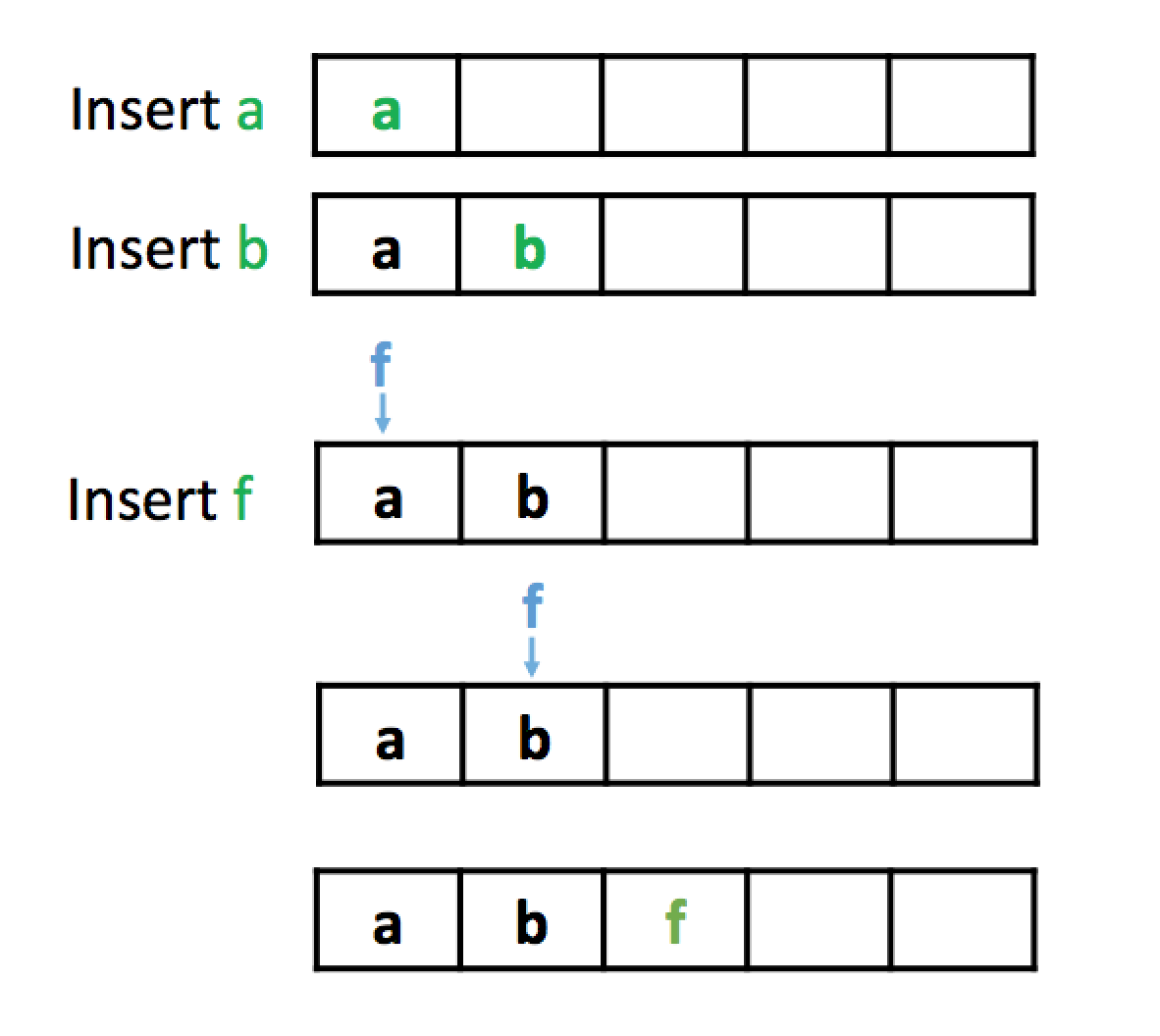
Terminology
- Open Addressing: The “address” of a key is not fixed; it is open to moving to a different index than its hash value.
- Closed Hashing: The key must stay “closed” within the boundaries of the backing array.
2. Implementation: Insert and Find
Insertion
To insert a key :
- Calculate
index = H(k). - If
arr[index]is empty, place there. - If
arr[index]is occupied, increment the index:index = (index + 1) % M. - Repeat until an empty slot is found. If you return to , the table is full and must be resized.
insert_LinearProbe(k): // Insert k into the Hash Table using Linear Probing
    index = H(k)

    Loop infinitely:
        if arr[index] == k:         // check for duplicate insertions
            return false

        else if arr[index] == NULL: // insert if slot is empty
            arr[index] = k
            return true

        else:                       // there is a collision, so recalculate index
            index = (index + 1) % M

        if index == H(k):           // we went full circle (no empty slots)
            enlarge arr and rehash all existing elements
            index = H(k)            // H(k) will index differently now that arr is a different size
The core of the Linear Probing algorithm is defined by this equation:
index = (index + 1) % MFinding a Key
The find algorithm must follow the same probe sequence. It starts at and scans linearly until:
- It finds the key (Success).
- It hits a
NULLslot (Failure—if the key were there, it would have been placed here or before this point).
3. The Deletion Problem: Lazy Deletion
You cannot simply set a slot to NULL when deleting a key. Doing so would break the “chain” of probes for other keys that collided at that spot.
Example: If key and key both hash to index 5, and is placed at index 6 via probing, deleting by setting index 5 to NULL would make impossible to find (the search would stop at the new NULL at index 5).
Solution: Tombstones
Instead of deleting the element at index, we set that index to be a “tombstone” index
We use a special “Deleted” flag (or Tombstone).
- Find treats a tombstone as an occupied slot and keeps searching.
- Insert treats a tombstone as an empty slot and can replace it with a new key.
4. Disadvantages: Primary Clustering
The most significant weakness of Linear Probing is Primary Clustering.
As slots fill up, “clumps” of keys form. These clumps are statistically more likely to grow because any key that hashes to anywhere inside the clump will be forced to the end of it, making the clump even longer. This turns operations into linear scans.
5. Better Alternatives
To avoid clumping, we use strategies that provide a different “skip” for each key:
- Double Hashing: Uses a second hash function to determine the step size ().
- Random Hashing: Uses a pseudorandom sequence seeded by the key to determine probe positions.
6. Performance Summary
| Feature | Linear Probing |
|---|---|
| Average Time | |
| Worst-Case Time | |
| Cache Locality | Excellent (Sequental memory access) |
| Main Weakness | Primary Clustering |
| Deletion Method | Lazy Deletion (Tombstones) |