ABSTRACT
Memory management relies on Pointer Arithmetic to navigate the heap and Metadata (headers) to track block status. By using bitwise logic, we can store both the size of a block and its “Busy/Free” status in a single 8-byte word.
1. Pointer Arithmetic Review
In C, array notation is essentially “syntactic sugar” for pointer math. The compiler automatically scales the addition based on the size of the data type.
| C Syntax | Pointer Equivalent | Description |
|---|---|---|
a[i] | *(a + i) | Dereference: Access the value at address a plus i offsets. |
&a[i] | a + i | Address: Get the specific address of the -th element. |
a[0] | *a | Base: Access the very first element at the start of the pointer. |
L-Value Definition: An “L-Value” represents a memory location (an address) that can appear on the left-hand side of an assignment (=). If a pointer operation results in an L-Value, you can write data to that specific memory spot.
2. Malloc Metadata: The Header
Every block on the heap is preceded by an 8-byte Header. This header is the source of truth for the allocator.

The LSB (Least Significant Bit) Trick
Because our allocator rounds all block sizes to multiples of 8, the last 3 bits of any size are always 000. We “borrow” the very last bit to act as a Boolean flag:
- Odd Number (LSB = 1): The block is Busy (Allocated).
- Even Number (LSB = 0): The block is Free.
EXAMPLE
Header = 33: Binary
...00100001. The size is 32 bytes (), and it is Busy.Header = 108: Binary
...01101100. The size is 108 bytes, and it is Free.
3. Allocation and Alignment
Computer architectures are optimized for aligned data. Our allocator ensures every request is rounded up to a multiple of 8, plus 8 bytes for the header itself.
The “Rounding Up” Rule: If a user requests 10 bytes:
- Add 8 bytes for the header = 18.
- Round up to the next multiple of 8 = 24 bytes total.
a = malloc(16); // Header 25 (16 user + 8 header + 1 flag)
b = malloc(40); // Header 49 (40 user + 8 header + 1 flag)
free(b);        // Header becomes 48 (Flag flipped to 0)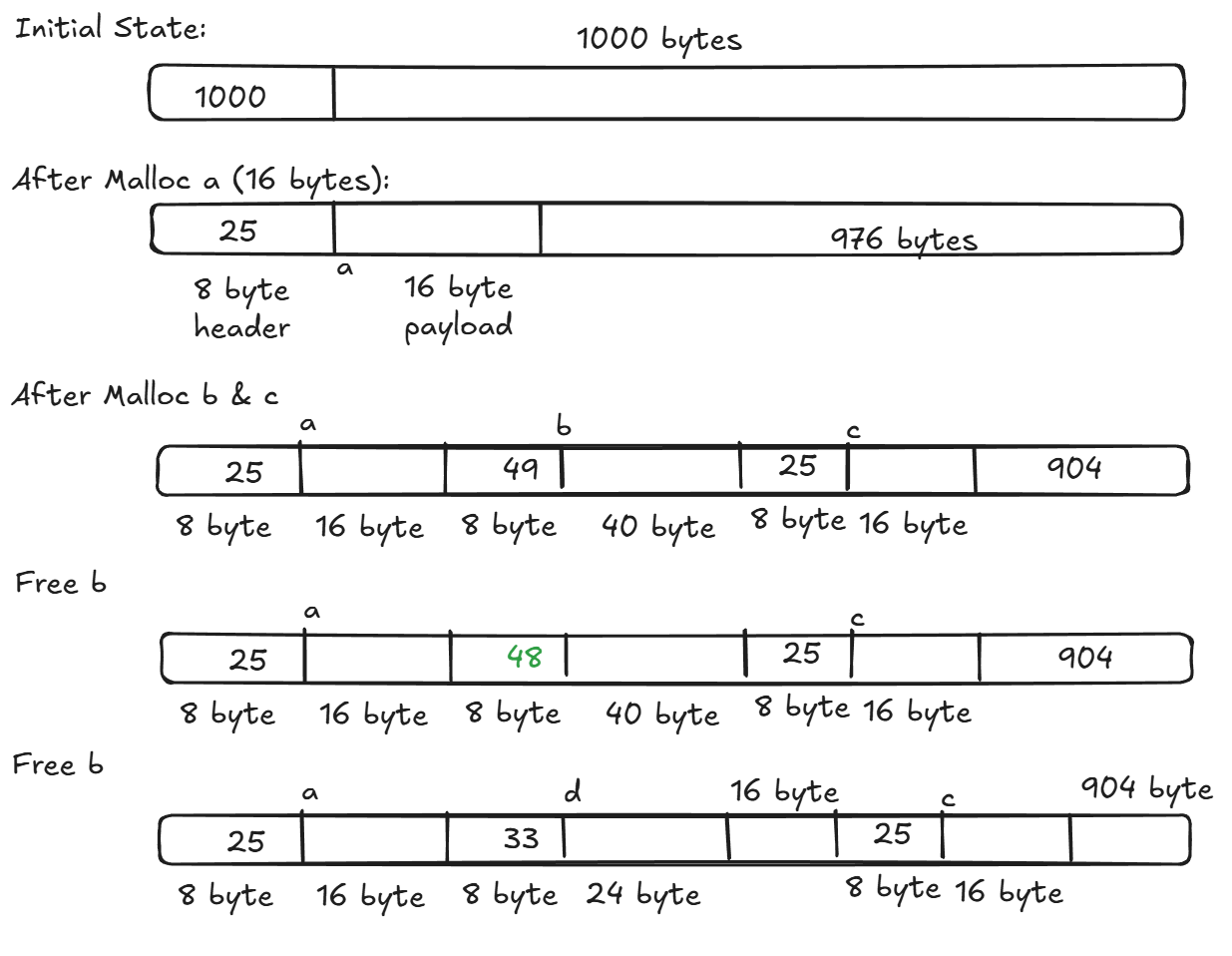
4. Logic of free()
When free(ptr) is called:
- The allocator looks at
ptr - 1(the word immediately preceding the data). - It performs a bitwise
ANDwith a mask to flip the LSB to 0. - Crucially, the user data inside the block is not wiped. It remains there until another
mallocoverwrites it, which is why “Use After Free” bugs can sometimes appear to work correctly before failing later.
Module Navigation
- Implementation of Malloc: See the code that implements this bitwise logic.
- Coalescing Heap: How the allocator uses these headers to merge adjacent free blocks.
- Memory and References: Reviewing how addresses are represented in hex.