ABSTRACT
Implementing
mallocinvolves requesting a large segment of memory from the Operating System and manually partitioning it into “blocks.” Each block uses a header to store metadata about its size and whether it is currently in use (Busy vs. Free).
1. Initializing the Heap
To start, the allocator must request a large chunk of memory from the OS. While the older sbrk is deprecated, modern implementations use mmap.
void init_heap(){
    // Request a chunk of anonymous, private, read/write memory from the OS
    HEAP_START = mmap(NULL, HEAP_SIZE_BYTES, PROT_READ | PROT_WRITE, MAP_PRIVATE | MAP_ANONYMOUS, -1, 0);
    // Initialize the very first header to represent the total heap size
    HEAP_START[0] = HEAP_SIZE_BYTES;
}- The Header: In this implementation, the header stores the total size of the block in bytes.
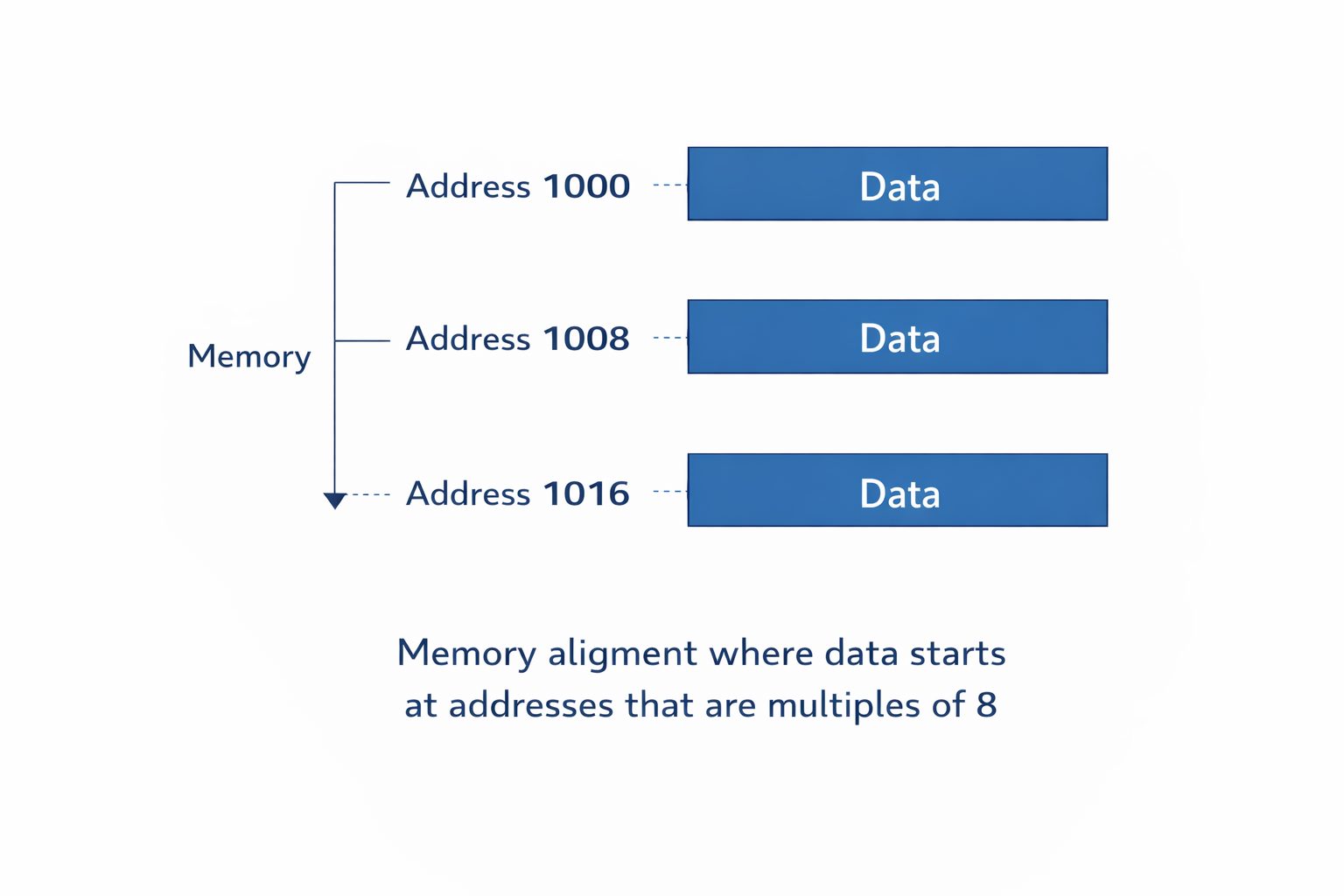
- LSB Trick: Since block sizes are aligned to 8 bytes, the least significant bit (LSB) is always 0. We use this bit as a flag:
0for Free,1for Busy.
2. Block Management Logic
The allocator performs three main tasks: finding space, splitting blocks to minimize waste, and freeing memory.
Finding a Block (find_block)
The allocator traverses the heap word by word, checking headers to find a free block large enough for the request.
uint64_t* find_block(uint64_t* start, size_t size){
    int i = 0;
    while(i < HEAP_WORDS){
        uint64_t header = start[i];
        if (header >= size && header % 2 == 0){ // Size is enough and LSB is 0 (Free)
            return &start[i];
        }
        i += header / 8; // Pointer arithmetic: jump to the next header
    }
    return NULL;
}
Splitting a Block (split_block)
If a found block is larger than needed, it is split into a Busy block for the user and a new Free block for the remainder.
- Busy Header:
size + 1(the +1 sets the Busy flag). - Remaining Free Header:
header - size.
Freeing Memory (free)
To free memory, the allocator moves back one word from the user’s pointer to reach the header and flips the Busy bit back to 0 using a bitwise AND with a mask (~1).
void free(void* ptr){
    uint64_t* p = ptr;
    p[-1] = p[-1] & (~1); // Access header via negative indexing and mark as Free
}
3. Byte Alignment and Word Math
C requires that memory returned by malloc be aligned (usually to 8 or 16 bytes) for CPU efficiency.
- Block Size Calculation: The function
block_size_ofensures the request is rounded up to the nearest 8 bytes, plus an additional 8 bytes for the header. - Pointer Arithmetic: When navigating
uint64_t*, adding 1 to the pointer moves it 8 bytes forward in memory.
4. Implementation Trace
When we allocate and free in sequence, we can see the heap structure evolve:
- Allocation: Blocks are marked Busy (e.g.,
25represents 24 bytes + Busy flag). - Freeing: A Busy block (49) becomes Free (48) after calling
free(). - Reuse: A subsequent
malloccan now take over that 48-byte free spot, potentially splitting it further.