Definition
An Abstract Data Type (ADT) where the element that is the first to go in is the first to be removed. This is known as the First In, First Out (FIFO) principle.
Operations
The Queue ADT is defined by three primary operations:
| Operation | Description |
|---|---|
enqueue(element) | Adds an element to the back of the Queue. |
peek() | Returns the value of the element at the front without removing it. |
dequeue() | Removes the element at the front of the Queue. |
Implementation via Deque
Since a Deques allows adding/removing from both ends, it serves as an ideal backing structure for a Queue. By “restricting” the Deque’s functionality, we can implement Queue operations with minimal code.
C++ Implementation
class Queue {
    private:
        Deque deque; // Backed by a Doubly-Linked List or Circular Array
    public:
        bool enqueue(Data element) { return deque.addBack(element); }
        Data peek() { return deque.peekFront(); }
        void dequeue() { deque.removeFront(); }
        int size() { return deque.size(); }
};
Python Implementation
class Queue:
    def __init__(self):
        self.deque = Deque()
    def enqueue(self, element):
        return self.deque.addBack(element)
    def peek(self):
        return self.deque.peekFront()
    def dequeue(self):
        self.deque.removeFront()
    def __len__(self):
        return len(self.deque)
Implementation Detail
Note that
dequeue()here isvoid(it only removes). In some languages like Java,dequeue(orpoll) removes and returns the value. In others like C++, the removal and the access (front()) are separate steps.
Visualization: The FIFO Process
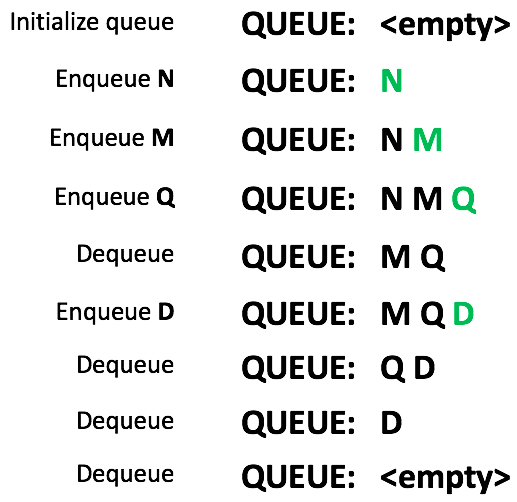
In the example above:
- Enqueue: Elements A,B,C are added to the back in order.
- State: The Queue is currently [A,B,C], where A is at the front.
- Dequeue: The operation removes A because it was the first to enter.
- Result: The new front of the Queue becomes B.
Analysis & Patterns
STOP and Think: Could we have used addFront(), peekBack(), and removeBack() instead?
- Yes. As long as the entry point and the exit point are on opposite ends, the FIFO property is maintained. Using one end for insertion and the other for removal is the only requirement.
Applications
Despite its simplicity, the Queue is essential for:
- Buffer Management: Organizing people at a cash register or print jobs in a printer spooler.
- Scheduling: Keeping track of CPU tasks that need to run in the order they arrived.
- Graph Exploration: Powering the Breadth-First Search (BFS) algorithm to find the shortest path in unweighted graphs.