Definition
A Circular Array is a regular Array Lists with a clever implementation that mimics the properties of a Linked List. It treats the underlying linear array as a continuous ring by using
headandtailindices.
- Head/Tail Indices: Instead of starting at index 0, the first element is at the
headindex and the last is at thetailindex. - Contiguity: Elements are contiguous in the logical sequence, even if they “wrap around” the physical end of the backing array.
Wrapping Logic
- Add to End: Increment
tail. If it hits the end of the array, it wraps back to index0. - Add to Front: Decrement
head. If it hits-1, it wraps to the last index (size - 1).
System Representations
There are two primary ways to conceptualize a Circular Array. Both are equally valid and describe the same underlying logic.
1. The Physical (Linear) View
This representation shows how the data actually sits in computer memory. The head and tail indices move across the array and “wrap” back to the other side when they hit the boundaries.
- Wrap to Front: If
tailreaches the end (size), it wraps to index 0. - Wrap to Back: If
headdrops below 0, it wraps to index size−1.

2. The Logical (Circular) View
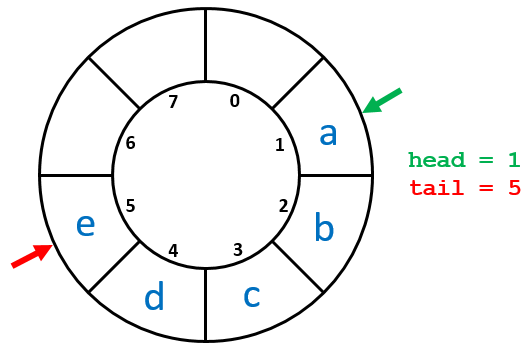
Since we only care about an element’s location relative to the head and tail, many prefer to visualize the structure as a ring. In this view, the “wrap around” is a natural part of the circular path.
Insertion and Resizing
When the backing array becomes full, it must be resized. Similar to a standard Array List, we double the size and copy the elements.
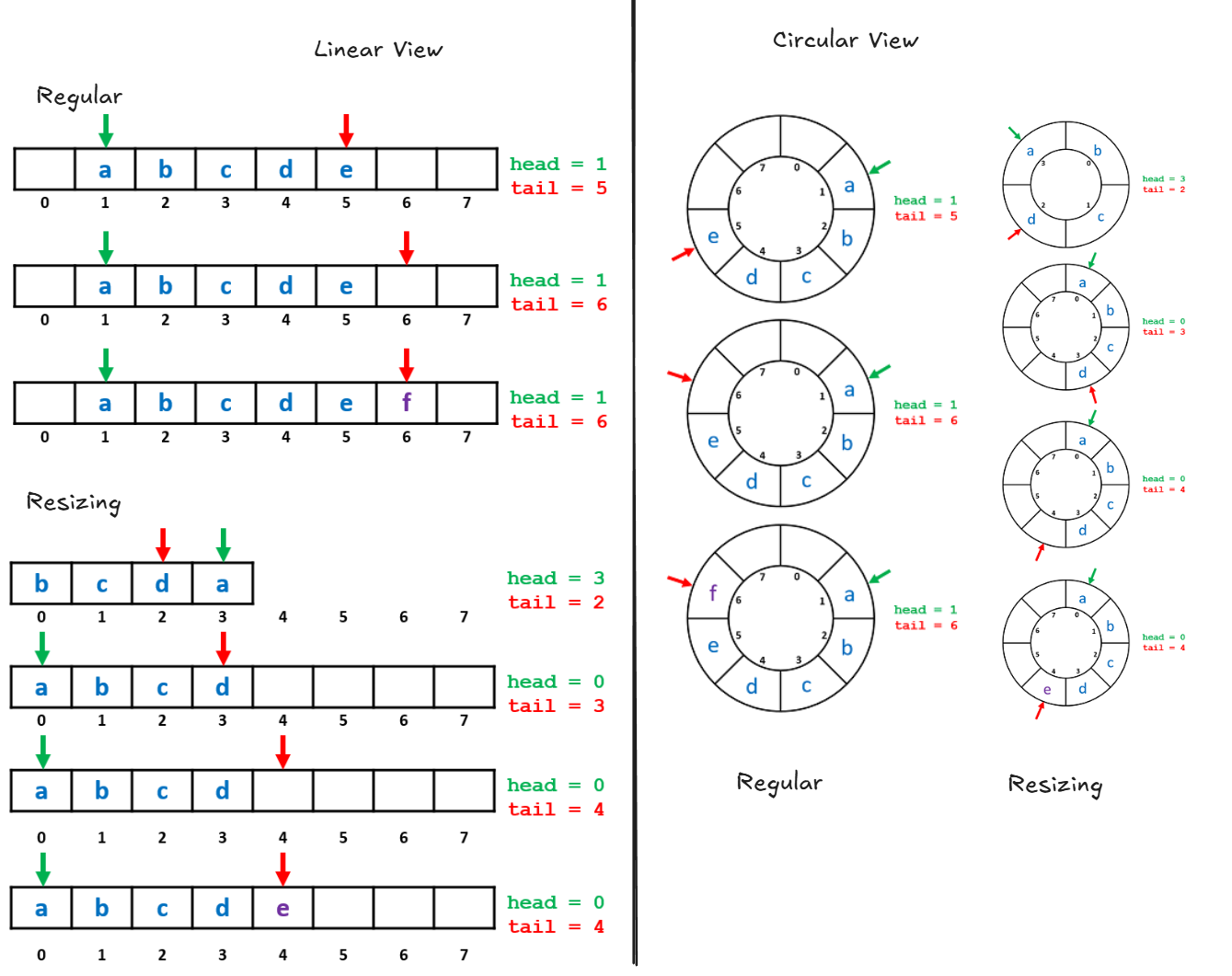
During a resize, you must "unroll" the circular structure so the new array begins with the
headelement at index0.
# Check and resize if full
checkSize():
    if n == array.length:
        newArray = empty array of length 2*array.length
        for i from 0 to n-1:
            # Copy using modular mapping
            newArray[i] = array[(head + i) % array.length]
        array = newArray
        head = 0
        tail = n - 1

# Insert at the front
insertFront(element):
    checkSize()
    head = head - 1
    if head == -1:
        head = array.length - 1
    array[head] = element
    n = n + 1

# Insert at the back
insertBack(element):
    checkSize()
    tail = tail + 1
    if tail == array.length:
        tail = 0
    array[tail] = element
    n = n + 1
Removal
- Remove Front: Erase the element at
headand increment theheadindex (wrapping if necessary). - Remove Back: Erase the element at
tailand decrement thetailindex (wrapping if necessary).
def removeFront():
    # erase array[head] (optional for non-pointers)
    head = (head + 1) % array.length
    n = n - 1

def removeBack():
    # erase array[tail]
    tail = tail - 1
    if tail == -1:
        tail = array.length - 1
    n = n - 1
Is it necessary to perform the "erase" steps?
Answer pointers, you must explicitly deallocate or null them to prevent memory leaks.
Usually no; the values will simply be overwritten by new insertions. However, if the array stores
Finding and Random Access
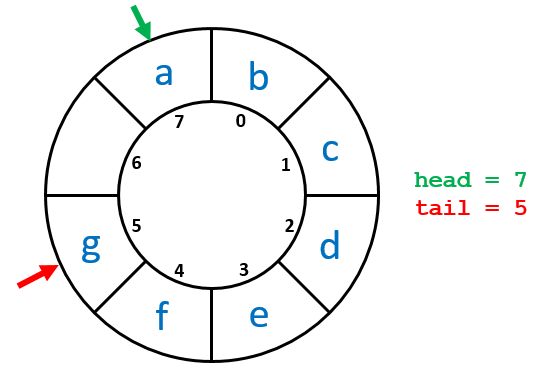
Unlike a Linked List, a Circular Array maintains Random Access. To access logical element i, you calculate the physical index:
When can we omit the modulo operation?
Answer .
When
Performance Summary
| Operation | Complexity | Note |
|---|---|---|
| Random Access | O(1) | Achieved via modular arithmetic. |
| Insert/Remove Front | O(1) | No shifting required (unlike Array Lists). |
| Insert/Remove Back | O(1) | Direct index adjustment. |
| Resize | O(n) | Occurs infrequently (amortized O(1)). |
Conclusion: Circular Arrays provide the efficient end-manipulation of a Linked List while retaining the O(1) random access of an Array List. This makes them ideal for implementing structures like Double-Ended Queues (Deques).