Description
Univalued Binary Tree A binary tree is uni-valued if every node in the tree has the same value.
Given the root of a binary tree, return true if the given tree is uni-valued, or false otherwise.
Examples
Example 1:
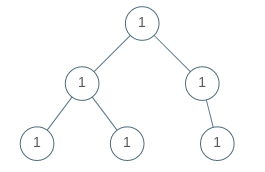
Input: root = [1,1,1,1,1,null,1] Output: true
Example 2:
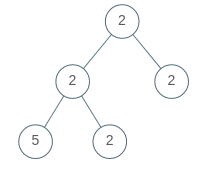
Input: root = [2,2,2,5,2] Output: false
Constraints
- The number of nodes in the tree is in the range .
Code
class Solution {
public:
    bool isUnivalTree(TreeNode* node) {
        // Recursive Implementation
        // First check to see if the current node has the same value as its left/right children
        // go to the children and see if they still have the same value
        if (node == nullptr) {return true;}
        bool leftValOK = node->left == nullptr || node->left->val == node->val;
        bool rightValOK = node->right == nullptr || node->right->val == node->val;
        if (!leftValOK || !rightValOK) {return false;}

        bool leftTreeOK = isUnivalTree(node->left);
        bool rightTreeOK = isUnivalTree(node->right);
        return leftTreeOK && rightTreeOK;
    }
};
Approach
- Check if there is a tree
- Check if left exist and its value is the same as root value
- Check if right exist and its value is the same as root value
- Check if both left and right node of the root is Univalue
- Recursively check for left subtree
- Recursively check for right subtree
- return the result