Question 1: Drawing slips from a hat
A hat contains slips of paper numbered 1 through 6. You draw two slips of paper at random from the hat, without replacing the first slip into the hat.
1(a) (5 points) Write out the sample space for this experiment
The sample space is the set of all possible results of the 2 slips of paper’s value. Since the first slip will not be replaced, it is impossible to get 2 of the same value
1(b) (5 points) Express the event as a subset of
1(c) (5 points) Find
1(d) (5 points) Let . What is
To satisfy this event, the larger number must be the same as the smaller number for their difference to be 0. Since there is no duplicates in , the event space is:
As such the probability for is:
1(e) (5 points) Are and disjoint? Why or why not
To find disjoint, we try to find the intersection between and
Since there is no common results between and , they are disjoint
1(f) (5 points) Find
Using the an axiom of probability, if and are disjoint, then the probability of or is:
Question 2: Cookie selection
(10 points) A box of cookies contains 5 chocolate chip and 10 sugar cookies. If 5 cookies are randomly selected, what is the probability that three are chocolate chip and two are sugar cookies
First we find the number of outcomes that satisfies the given condition:
where:
- represents the number of outcomes to choose 2 sugar cookies at random from 10 total sugar cookies
- represents the number of outcomes to choose 3 chocolate chip cookies from 5 total chocolate chip cookies
Next, we find the total sample space to choose 5 cookies out of 15 total cookies:
As such the probability for the event will be:
Question 3: Inclusion–Exclusion principle for three events
Given three events , we want the probability of
Let .
3(a) (5 points) Define the event . What is the event in relation to
The set was defined to be: ” or or occurred” The expression , on the other hand, represents “A or B occurred”
So:
Therefore the expression is equivalent to the event
3(b) (5 points) Using Rule 5, write down the expression for
3(c) (5 points) In words, what does the event represent
This expression represents “both C and at least A or B occurred”
3(d) (5 points) Show that using set identities or a Venn diagram
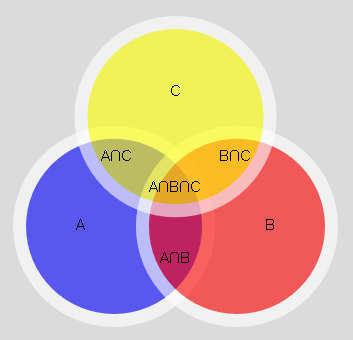
With this image, we can see the Venn Diagram of the variables , and :
- covers the areas
- As such, covers the areas in
When viewing it again in a different perspective
- covers all intersections that was mentioned in
With that, it is clear that the statement is true
3(e) (5 points) Using the identity above, use Rule 5 to write down the expression for
3(f) (5 points) In words, what does represent? Is it the same as
This statement represents “both and occurred and both and also occurred”. Both and guarantees the occurrence of , therefore this statement is logically the same as
3(g) (5 points) Combine your answers from (b) and (e) to write down the final expression for
Question 4: Conditional probability with a union
(10 points) Let be two events. Show that
You may argue algebraically from the axioms or with a Venn diagram.
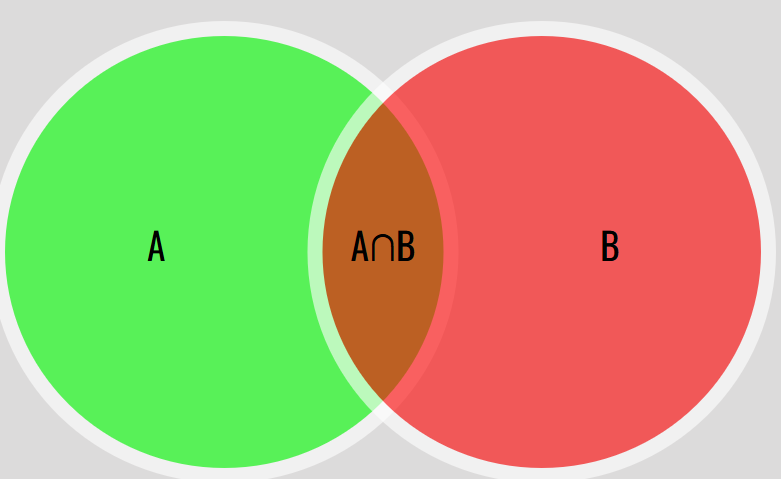
From the image, the set represents the space that is either green or red or both. With the expression suggests that we know has already occurred. But because is a subset of , the event has already occurred by the given. Therefore the probability is accurate
Question 5: Two dice (one white, one red)
Events:
5(a) (5 points) Which pair(s) of events among are disjoint
The events and are disjoint
5(b) (5 points) Which pair(s) of events among are independent
The events and are independent
5(c) (5 points) In words, what does the event represent, and compute
The event represents the 2 dice has a sum of where the white dice rolled an odd number
The probability of this event is:
5(d) (5 points) In words, what does the event represent, and compute
The event represents the 2 dice has a sum of and rolled the the same number
The probability of the event is:
5(e) (5 points) In words, what does the event represent, and compute
The event represents the 2 dice rolled the same number given that the white dice rolled an odd number
The probability of the event is:
5(f) (5 points) In words, what does the event represent, and compute (Hint: Use Bayes’ Rule)
The event represents the white dice rolled an odd number given that both dice rolled the same value.
By using the Bayes theorem, we can find the probability of this event to be:
Question 6: Casino D6 game
At a casino game, you roll a D6 die and, based on the outcome , you win or lose
dollars. Let be the random variable denoting your winning/loss.
6(a) (5 points) What is
6(b) (5 points) Write down the probability mass function
6(c) (5 points) Express the event “you don’t win any money” in terms of
6(d) (5 points) What is the probability of this event
6(e) (5 points) Calculate your expected winning
6(f) (10 points) What is the variance and what unit of measurement is in
The unit of is dollar squared
Question 7: Variance of a linear combination
In class we saw that the expectation is linear: for random variables and ,
Assume .