ABSTRACT
This section covers the relationship between pointers and arrays. We explore why passing arrays in C requires explicit length parameters and how to perform manual memory operations like appending.
1. Pointers vs. Arrays
In C, when you pass an array to a function, you are actually passing a pointer to its first element.
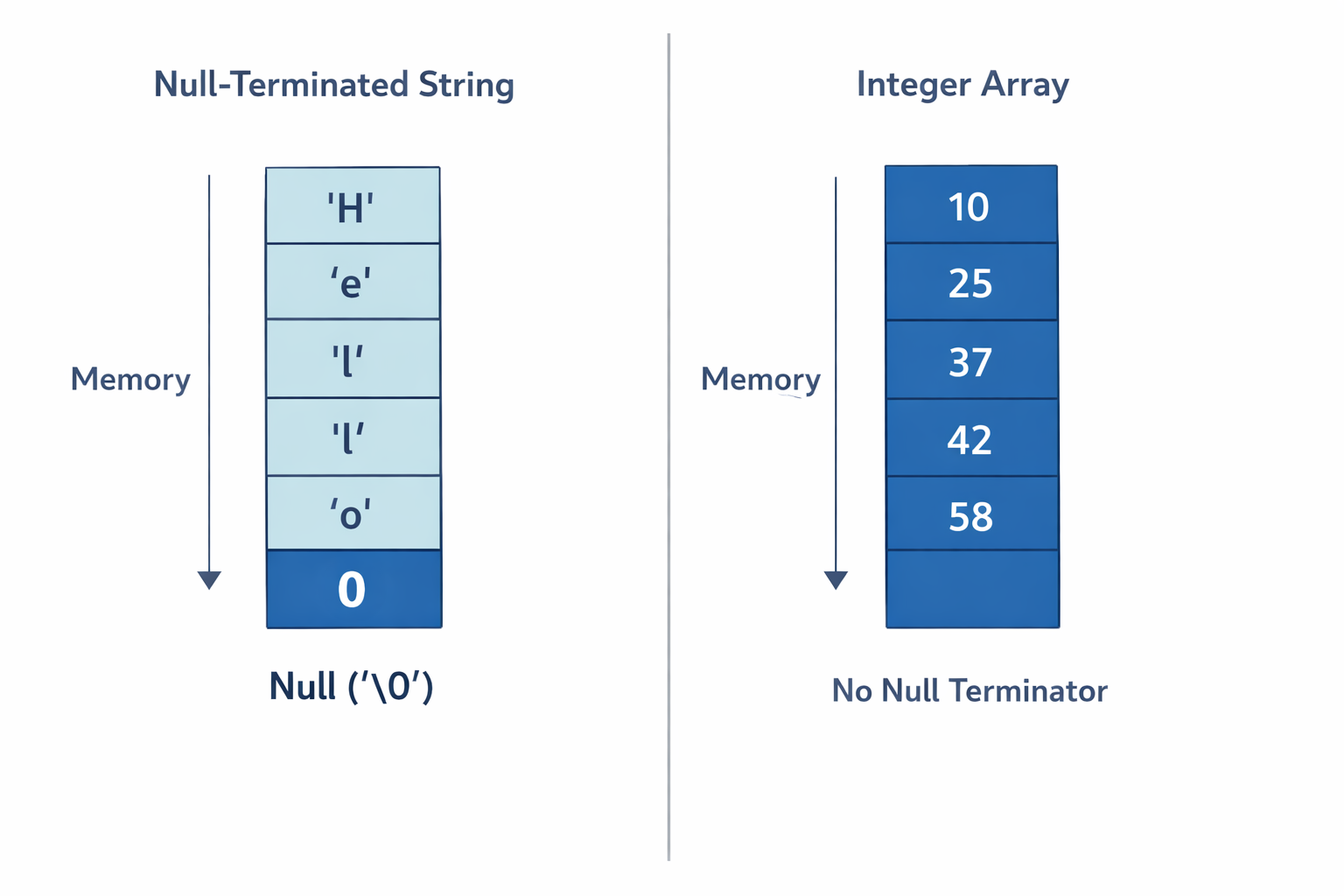
T*: Represents an address where we can access data of typeT.- The “Size” Problem: Unlike C strings, standard arrays are not null-terminated. A function receiving
double a[]has no way of knowing where the array ends unless we tell it.
2. Implementation: The append Pattern
To safely manipulate arrays, our function signatures must include lengths for every array passed.
Revised Function Signature
// Takes two double arrays a and b, and changes result to have the concatenated data.
// ASSUMES that result has at least (alen + blen) elements of space.
void append(double a[], int alen, double b[], int blen, double result[]);
The Logic
We must manually “offset” the second array into the result buffer by using the length of the first array.
void append(double a[], int alen, double b[], int blen, double result[]) {
    // Copy first array starting at index 0
    for(int i = 0; i < alen; i++) {
        result[i] = a[i];
    }

    // Copy second array starting at index 'alen'
    for(int i = 0; i < blen; i++) {
        result[i + alen] = b[i];
    }
}
3. Usage Example
Notice how we must track 3 and 4 manually in the main function.
int main() {
    double n1[] = {4.0, 5.0, 6.0};      // Length: 3
    double n2[] = {0.7, 0.3, 0.1, 0.8}; // Length: 4
    double result[7];                   // 3 + 4 = 7

    append(n1, 3, n2, 4, result);

    print_list(n1, 3);
    print_list(n2, 4);
    print_list(result, 7);
}
4. Comparison: Strings vs. Arrays
| Feature | C Strings (char)* | Numeric Arrays (double[], int[]) |
|---|---|---|
| Termination | Null-terminated (\0) | No built-in terminator |
| Size Tracking | Functions like strlen() work | Length must be passed as an int |
| Memory | Contiguous in memory | Contiguous in memory |
 |
Key Takeaway for Systems Programming
When working with raw memory or system calls, always pass the size. Relying on “assumptions” about array boundaries is a primary cause of buffer overflows and security vulnerabilities.