ABSTRACT
Random sampling is a technique used to select a subset of individuals or outcomes from a larger population. The goal is to ensure that the sample accurately represents the characteristics of the whole, often by ensuring every outcome has a known or equal probability of being chosen.
Uniform Random Sampling
INFO
A Uniform Random Sampling of a sample space is an experiment that yields one outcome from such that each outcome of is equally likely to occur.
Simulating Distributions
Uniform sampling can be used to simulate different probability distributions by partitioning the sample space.
- Simulating a Coin with a Die: To generate and with using a six-sided die, group the outcomes into two equal sets:
- Simulating a Die with a Coin: This requires multiple flips to create a large enough sample space (at least outcomes) to cover the 6 faces of a die. Outcomes that do not map to a die face are handled via Rejection Sampling.
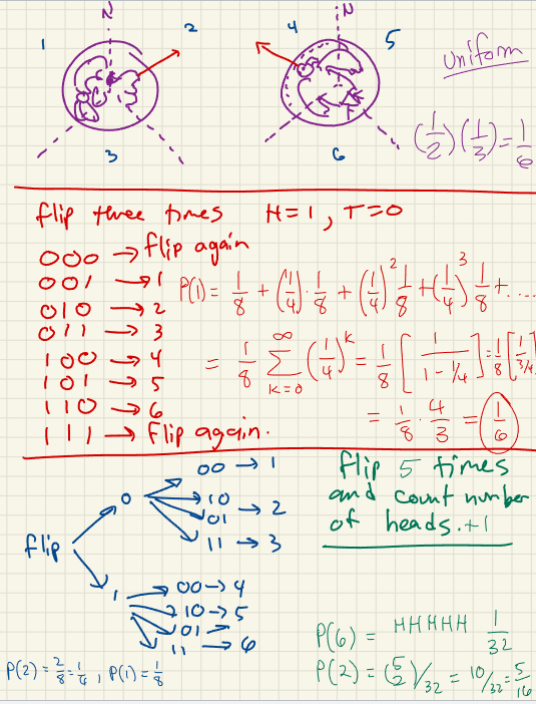
Rejection Sampling
Rejection sampling is a procedure used to simulate a selection from a subset (uniformly at random) when you only have the means to select from the larger set .
The Procedure
- Select an outcome from the larger set uniformly.
- Verify: If , keep it as your result.
- Reject: If , discard the result and return to Step 1.
NOTE
This method is highly effective for simulating specific distributions (like a 6-sided die) using binary sources (like a coin). You generate enough bits to exceed the target range and “reject” any value outside that range.
Related Notes
- Counting and Probability: The foundation for determining the size of sample spaces and .
- Uniform vs Non-Uniform Distributions: Understanding the difference between equally likely outcomes and weighted sampling.
- Expected Value: Used to calculate how many “trials” on average it takes for Rejection Sampling to succeed.
- Geometric Distribution: The number of attempts until a successful sample is kept in Rejection Sampling follows a geometric distribution.