ABSTRACT
Determining the runtime of an algorithm involves analyzing the growth rate of its execution time relative to the input size . We use Asymptotic Notation () to provide upper, lower, and tight bounds, often applying the Product and Sum rules to decompose complex loops.
1. Product Rule for Loops
If a loop runs times and the body of that loop takes to execute, the total time is:
The “Tightness” Trap
While the product rule always provides a valid upper bound (), it is not always a tight bound (). A pessimistic upper bound occurs when the “worst case” of the inner logic rarely happens across all iterations of the outer loop.
Example: Disjoint Set (Two-Pointer Method)
To check if two sorted lists are disjoint (no common elements), we use two pointers, and .
- Pessimistic View: The outer loop runs times, and the inner logic seems to “interact” with elements. One might guess .
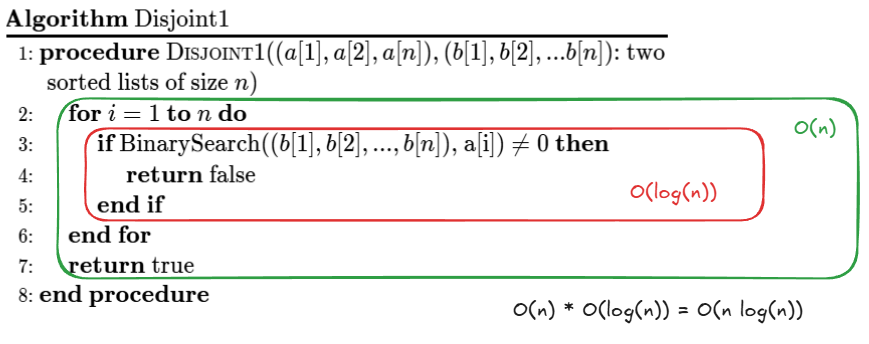
- Actual Runtime: In each comparison, either increments or increments. Neither pointer ever resets. Since each pointer can only move times, the total number of operations is at most .
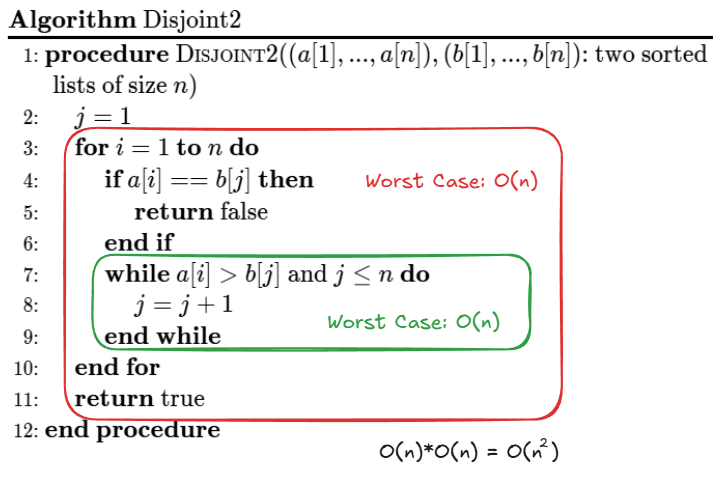
- Result: The runtime is , even though a naive product rule might suggest higher.
2. Sum Rule for Processes
If an algorithm performs two distinct tasks sequentially—first Process A then Process B—the total runtime is the sum of their individual runtimes:
In asymptotic analysis, this simplifies to the maximum of the two: .
3. Proving Tight Bounds ()
To conclude that an algorithm is , you must prove both the upper and lower bounds.
Example: Selection Sort Comparisons
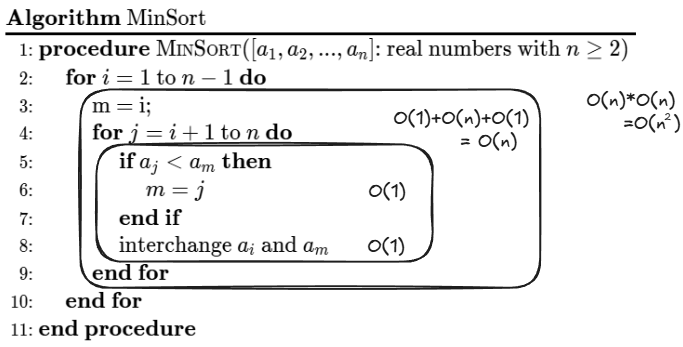
Consider the nested loop structure of Selection Sort (MinSort):
-
Lower Bound (): By counting the number of comparisons:
This is a polynomial of degree 2, so .
-
Upper Bound (): By the Product Rule, the outer loop runs times and the inner loop runs at most times. Thus, .
IMPORTANT
Because AND , we can state definitively that:
4. Analysis Summary
| Rule | Mathematical Form | Common Usage |
|---|---|---|
| Product Rule | Nested loops, multiplying iterations by body cost. | |
| Sum Rule | Sequential blocks of code or function calls. | |
| Tight Bound | When and meet, describing the exact growth rate. |