ABSTRACT
Pascal’s Identity states that . Combinatorially, this represents splitting a selection process into two disjoint cases based on whether a specific “special” element is included or excluded.
Proof 1: Algebraic Manipulation
We can prove the identity by expanding the binomial coefficients into their factorial forms and finding a common denominator.
LHS:
RHS:
-
Find Common Denominator: The common denominator is .
-
Multiply to match:
- Multiply the first term by .
- Multiply the second term by .
-
Combine and Simplify:
LHS = RHS
Proof 2: Combinatorial Interpretation
As you noted, we can think of this as counting binary strings of length with exactly ones. By the Sum Rule, we can partition all such strings into two mutually exclusive sets based on the value of the last bit.
LHS: Total Count
The total number of binary strings of length with ones is .
RHS: The Partition
- Case 1: The string ends in 1 If the last bit is a 1, we have remaining positions to fill and we only need more 1s. Number of ways:
- Case 2: The string ends in 0 If the last bit is a 0, we still have positions to fill, but we still need to place all of our 1s. Number of ways:
Since a string must end in either 1 or 0, the total is the sum of these two cases.
Pascal’s Triangle Connection
This identity explains the structure of Pascal’s Triangle.
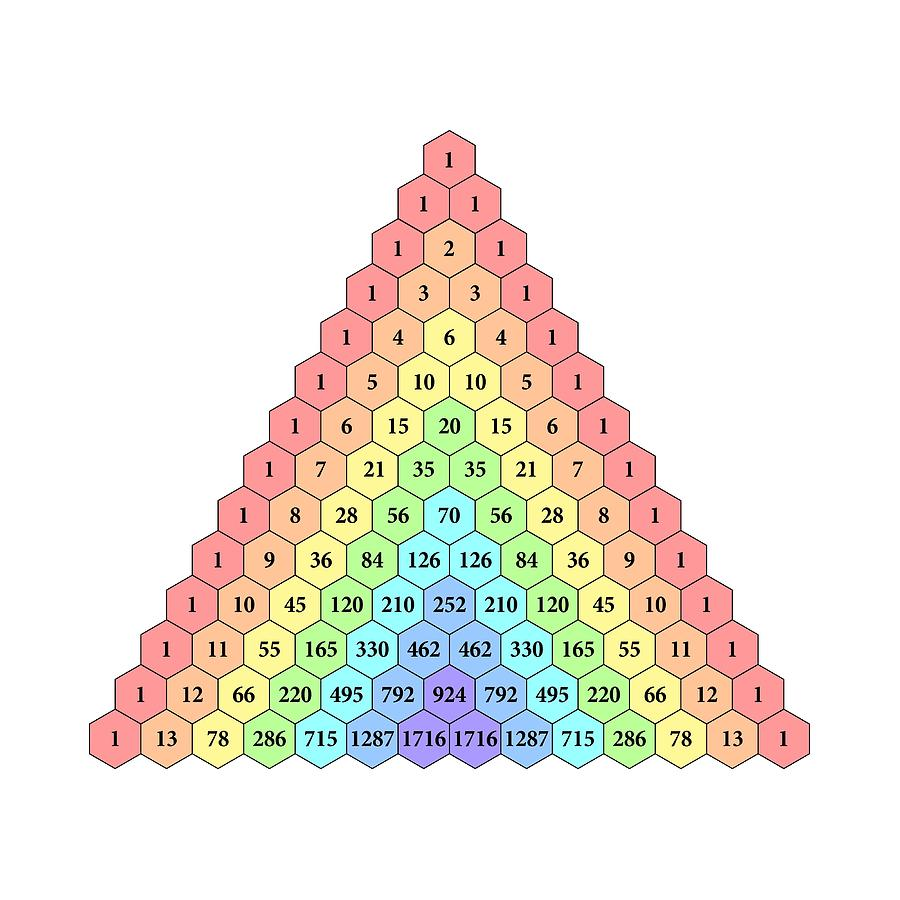
Each interior number is the sum of the two numbers above it because those two numbers represent the “Include” and “Exclude” cases for a set of size .
Visual Example:
- : Ways to pick 3 people for a team out of 5 friends (Alice, Bob, Charlie, Dan, Eve).
- : Teams that include Alice. (We must pick 2 more from the remaining 4).
- : Teams that exclude Alice. (We must pick all 3 from the remaining 4).