INFO
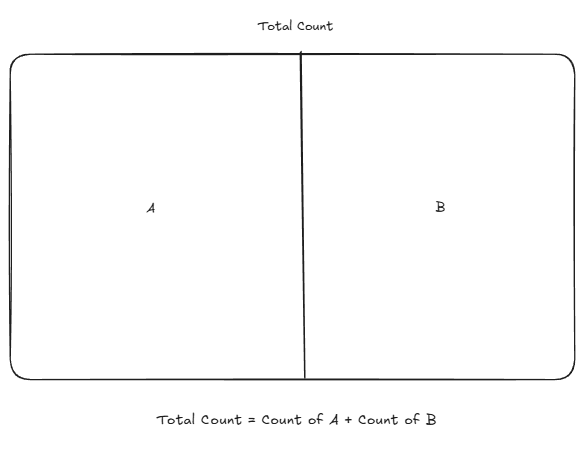
For any disjoint sets and ,
Keyword: OR
More Generally
To count the number of disjointed pairs:
- Count the number of choices in the first disjoint set
- Count the number of choices in the second disjoint set
- Add those two counts
CAUTION
This rule only applies when the sets are disjoint—i.e., they share no elements. If sets overlap, use the Principle of Inclusion-Exclusion instead.
Example
Suppose you have:
- 5 red shirts
- 7 blue shirts
If you want to know how many shirts you can choose either red OR blue, the total is:
Edge Case
If sets are not disjoint, then:
This is a basic form of the Inclusion-Exclusion Principle.