INFO
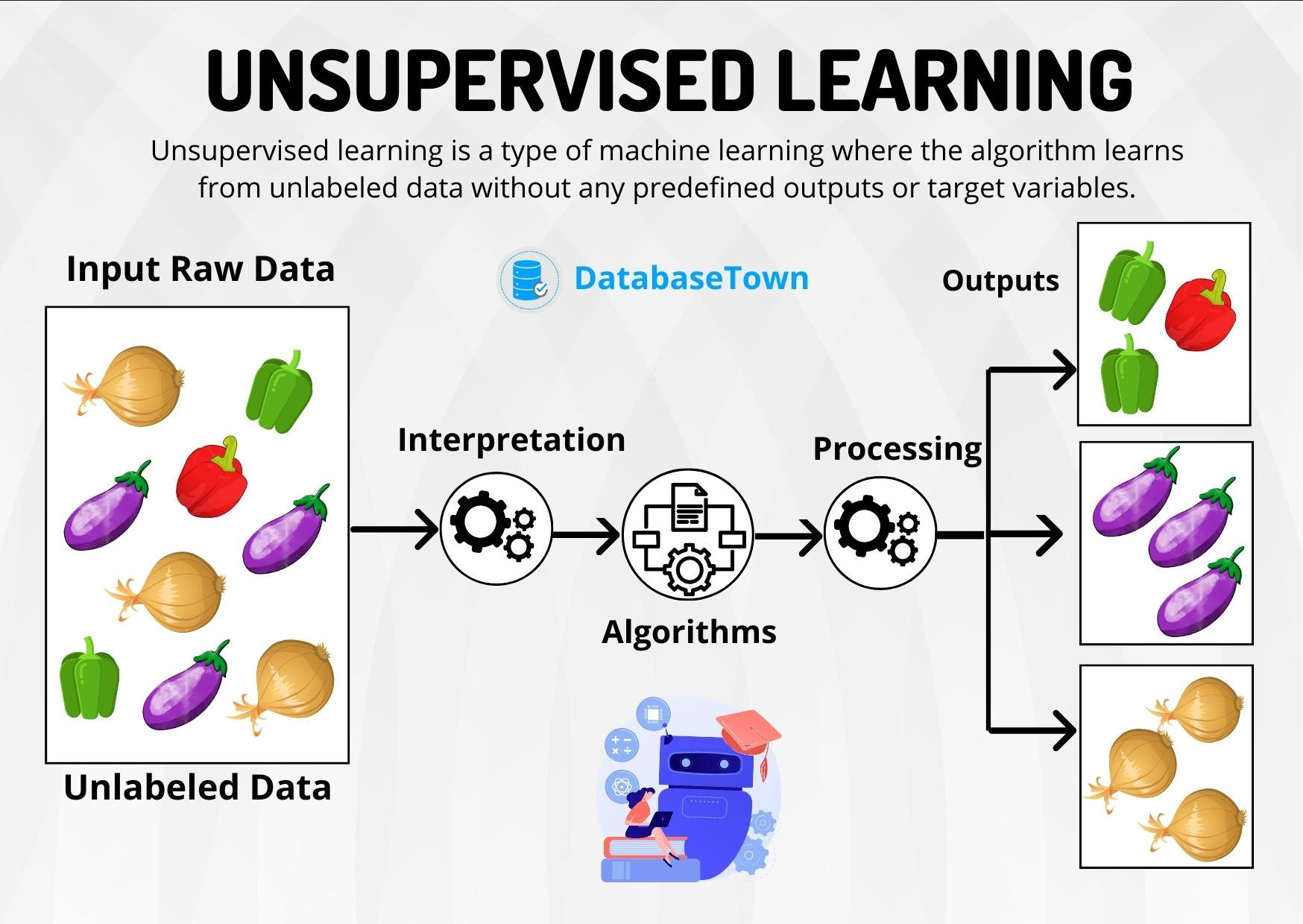
Unsupervised Deep Learning refers to neural network-based methods that learn patterns, structures, or representations from unlabeled data. These models aim to discover hidden structure, reduce dimensionality, or generate new data without explicit supervision.
Overview
Unlike supervised learning, unsupervised deep learning does not rely on labeled input-output pairs. Instead, it focuses on learning from the data’s internal structure—such as correlations, clusters, or latent representations. These models are foundational in tasks like:
- Feature learning
- Dimensionality reduction
- Generative modeling
- Anomaly detection
- Representation learning
Unsupervised deep learning is often used as a pretraining step, a data compression tool, or a generative engine in hybrid systems.
Included Models
Learns to compress and reconstruct input data. Useful for dimensionality reduction, denoising, and anomaly detection.
Consists of a generator and discriminator in a minimax game. Used for realistic data generation, image synthesis, and augmentation.
Topology-preserving neural networks that project high-dimensional data onto a low-dimensional grid. Useful for clustering, visualization, and exploratory analysis.
Key Concepts
- Latent Representations: Compressed or abstract features learned from raw data
- Reconstruction Loss: Measures how well the model can reproduce input data
- Generative Modeling: Learns to generate new samples from learned distributions
- Clustering and Embedding: Groups similar data points or maps them to lower-dimensional spaces
- Self-Supervision: Uses internal signals (e.g., masked inputs) to create pseudo-labels for training
Applications
- Image compression and denoising
- Text embedding and topic modeling
- Anomaly detection in sensor or transaction data
- Pretraining for downstream supervised tasks
- Synthetic data generation for simulation or augmentation
Suggested Links
- Unsupervised Learning — Broader context including classical models
- Hybrid Deep Learning Models — For architectures combining unsupervised and supervised components
- Model Evaluation — For metrics like reconstruction error, clustering purity, or likelihood