INFO
This section covers deep reinforcement learning (DRL) algorithms that combine neural networks with reinforcement learning principles to solve complex decision-making tasks in high-dimensional environments.
Overview
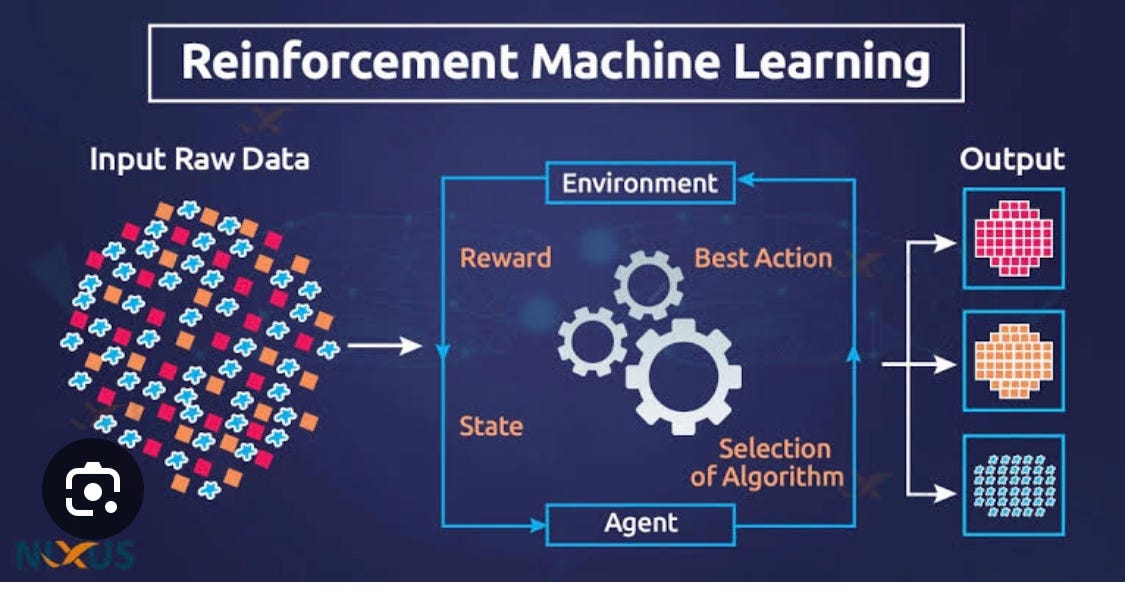
Reinforced Deep Learning Models leverage deep architectures to approximate policies, value functions, or both. These models are especially effective in environments with:
- Continuous or discrete action spaces
- Sparse or delayed rewards
- High-dimensional state representations
They are commonly used in robotics, game AI, autonomous systems, and industrial control.
Included Models
A value-based method that uses a deep neural network to approximate the Q-function. Introduced experience replay and target networks for stability.
An off-policy actor-critic algorithm for continuous action spaces. Combines deterministic policy gradients with Q-learning.
A policy optimization algorithm that balances exploration and stability using clipped surrogate objectives.
Key Concepts
- Policy Networks: Learn to map states to actions
- Value Networks: Estimate expected future rewards
- Exploration Strategies: Balance between trying new actions and exploiting known ones
- Replay Buffers: Store past experiences for off-policy learning
- Target Networks: Stabilize training by decoupling updates
- Gradient-Based Optimization: Used to update neural parameters
Suggested Links
- Reinforcement Learning ← Broader RL context
- Supervised Deep Learning ← For hybrid comparisons
- Hybrid Deep Learning Models ← For models combining DRL with other paradigms
Use Cases
- Autonomous Navigation
- Robotic Manipulation
- Game Playing Agents
- Industrial Control Systems
- Financial Portfolio Optimization